

Showing posts with label South Weymouth dentist. Show all posts
Showing posts with label South Weymouth dentist. Show all posts
Monday, March 30, 2015
The Toothboss in the Weymouth News

Monday, July 7, 2014
Thank you for making the Toothboss the #1 Choice in Weymouth

The Toothboss is the proud recipient of the Gold Award for WickedLocal's Reader's Choice as the #1 Dentist/Dental Office in Weymouth and the South Shore. Thanks to you, our loyal patients, for your continued patronage and support.
And one thing is for certain. You don't have to worry about the gold going to our head. The Toothboss will continue to provide the same comprehensives, contemporary and compassionate care we have for the past 20-plus years.
Thank you, once again, for your continued support. We know there are many places you can go to receive your dental care. We thank you for choosing The Toothboss.
Monday, July 1, 2013
A donation with some teeth to it. Rasin Foundation helps The Toothboss go paperless.

I first heard about the Rasin Foundation, a Milton, MA-based non-profit from a fellow National Guardsmen, Dr. Fidel Gabriel. Fidel is a native of Haiti and he told me of the Foundation’s efforts to get supplies to start a dental practice in Leogane, Haiti. When I asked what types of items the Foundation would accept and mentioned my filing system, it was a no-brainer on this end as to what to do.
The filing system itself costs approximately $2500 but I was prepared to eat the cost of that because I believe going paperless far outweighed the cost. To find an organization like the Rasin Foundation that could benefit from the donation of the filing system was icing on the cake. The fact it was going to help a dental practice was the cherry on top.
As you can imagine, the equipment and technology that we enjoy and perhaps take for granted here in the U.S. aren’t available in remote places like Leogane, Haiti. I encourage dentists, doctors and other health care professionals to visit The Raisin Foundation’s website to see if they need other items. One man’s upgrade is another’s treasure.
For more information, visit www.RasinFoundation.org.
Monday, May 13, 2013
Going to the dentist is for the birds.
 |
| A patient's view at The Toothboss |
Actually, the birds are for the patients. At least that’s
what we tell patients when seated in our examination rooms and looking out the
window to see a plethora of birds feasting at our bird feeder. The fact is we enjoy
checking out the cardinals, finches, chickadees, woodpeckers and other birds
those feeders attract.
Going to the dentist can be an unnerving experience for some
patients. With our newly renovated waiting room and office area, as well as our
examination rooms, we try to create a calming, stress-free environment. The
bird feeders are part of that effort (we also have a fish tank in the dental
hygienist’s examination room).
The bird feeders serve a couple of purposes. First, they
offer a distraction for patients to take their mind off what the work being
done (we positioned the feeders so patients can view the birds and keep their
head in position for their examination). Second, bird-watching does have a
soothing effect. This can be particularly effective with younger patients who
are easily distracted.
For some patients, a trip to the dentist can cause
debilitating anxiety that interferes with the dentist being able to do their
work. For some people who are biters, their anxiety can create a dangerous situation
for the dentist. That’s why many dental practices, including The Toothboss,
offer sedation therapy as a stress-free way to get your dental work done.
Friday, April 19, 2013
What’s missing in bottled water for kids? Plenty.

Fluoride is critical for growing strong, healthy teeth. For younger patients, fluoride actually hardens teeth, making them more cavity-resistant. Unfortunately, more and more people are opting for bottled, filtered water, which has no fluoride.
Some communities, like Weymouth, have fluoride in the water—a great way to help their children grow strong healthy teeth. Because of the taste, many people prefer bottle water or filtered water over tap water and pass that habit on to their children. But kids still need fluoride to help their teeth develop.
How much? According to the American Dental Association, children should consume fluoride through drinking water or supplements in the following amounts:
·
Birth to six months – none
·
Six months to three years - .25 mg/day
·
Three to six years - .5 mg/day
·
Six years to 16 years – 1 mg/day
Many dentists have younger patients take fluoride supplements, whether they live in a community where the tap water has fluoride or not. If your child is under 10 and not taking supplements, please contact our office at 781-335-0604.
To find out whether or not your town is a fluoridated community, please click on this link to go to a map from the Massachusetts Dental Society website, www.massdental.org. You can also call your town’s Water Department.
Friday, April 5, 2013
A reason to brush with your kids
One reason
parents brush their teeth with their children is to make sure they are brushing the way the dentist instructed. Perhaps a better reason is so parents can
remind themselves to do the same. Particularly as it pertains to time.
Most
dentists recommend you brush your teeth a minimum of two minutes at a clip,
twice a day. In fact, there are many children’s toothbrushes that light up for
that amount of time so children know how long to brush. The Toothboss actually
gives some of our younger patients hour glasses so children can know how long
to brush.
While we don’t
really have something like that for grownups, there really is no age limit on
the hour glasses. And if your last checkup didn’t go so well, brushing longer,
in addition to flossing, is one way to get better results.
As far as frequency of brushing is
concerned, ideally you want to brush your teeth after each meal. But if you
can’t, brush at least twice a day- after breakfast and before going to bed.
If you have any questions about brushing
technique in or around South Weymouth, give us a call today!
Friday, December 7, 2012
Dr. Wolfert discusses dental implants
Need a tooth replaced? Dr. Wolfert, AKA "The Toothboss" explains the differences between bridges and dental implants.
Friday, June 22, 2012
Do you know what your dental insurance covers?
Dental benefits first became available in 1974. Back then, the average benefit coverage was $1,000. Does that sound familiar? If you have dental coverage it probably does because the average dental benefit in 2012 is about $1,000.
To put that into perspective, in 1974, a brand new Mustang cost about $2500. Today, a 2013 Mustang starts at $22,200!
What this means for patients is you need to know what your dental insurance covers and up to how much. Then, when you visit the dentist for more than a cleaning or check-up, ask him or her if your dental plan covers the procedure. Or, how much will it cost out of pocket.
For example, some people prefer composite fillings, which are white, compared to the traditional amalgam fillings. There is a price differential between the two filling types, composite are more expensive. Most insurance plans will not cover the difference. Consequently, many people who want composite fillings end up paying $50 or more out of pocket.
That’s not to be completely critical of dental insurance plans. Many of the most severe problems patients come to me could have been avoided with better daily care on their part and regular trips to the dentist for check-ups. And dental insurance, if nothing else, does make it easier for people to get to the dentist regularly. But if you need more than a check up, a call to your dental insurance provider about what’s covered is a great start.
Friday, April 27, 2012
Random oral hygiene and dental health facts
I was
recently perusing the American Dental Hygienists Association website and came
across some rather interesting facts. In no particular order, here they are:
- Snacking on celery, carrots, or apples helps clear away loose food and debris.
- Toothbrushes should be replaced every two to three months and after illnesses like a cold or flu.
- Oral cancer occurs twice as frequently in men as women
- Dental hygienists screen for serious health problems, such as HIV infection, oral cancer, eating disorders, substance abuse and diabetes.
- Chewing gum can help eliminate food particles caught between teeth after a meal and also helps prevent plaque build up by stimulating saliva production.
- The biggest oral health problem for infants is early tooth decay, known as baby-bottle tooth decay. This results when babies routinely fall asleep with bottles filled with sugary liquids such as milk, formula, and juice—anything other than plain water.
Monday, January 9, 2012
Are you a candidate for dental implants?

During the last 20 years dental implants have become a great alternative to other methods of replacing missing teeth. Excellent success rates and a variety of available options give dentists many new ways to treat and replace lost teeth.
Your dentist will be able to evaluate your case and tell you if you are a candidate for dental implants. Basically, a dental implant is a Titanium based cylinder that replaces the missing tooth root. After a period of time and when the implant is taken other parts will be placed on the implant that enables your dentist to eventually place a crown (cap) on the implant.
Implants also can be used to support full or partial dentures. They dramatically improve the denture retention and stability.
Most patients with enough amount of bone can have implants, although individual decisions are made between you and your dentist. Usually an x-ray and a CT-scan is done to determine if you have enough bone to place the implant and also to determine the size and kind of the implant that should be placed.
If you would like to know if you're a candidate for dental implants, please give our office a call at 781-335-0604.
Tuesday, December 20, 2011
Dental Insurance 101. What you don’t know could you hurt you and your wallet

Most dental insurance companies classify dental procedures in three categories:
- Preventative – This typically includes routine cleanings and examinations as preventative dental care, however, X-rays, sealants and fluoride can be deemed as preventative or basic, depending upon the specific insurance carrier.
- Basic or Restorative – This usually consists of fillings and simple extractions. Root canals can be considered basic or major depending on the plan (the majority of dental plans list root canals as basic).
- Major – Usually includes crowns, bridges, dentures, partials, surgical extractions and dental implants. But not always.
Friday, December 2, 2011
Don’t forget to use all your dental healthcare benefits for 2011

Most dental plans allow for a certain dollar amount of dental coverage per year once you reach your deductible. Unfortunately, many people often delay dental work until after the holidays. Not only does that mean you have to meet a brand new deductible but you can use up a lot of your covered care dollars very early in the year. That can leave you vulnerable later on in the year if you need additional dental work.
So, if you know you need more dental work and you want to leave yourself adequate coverage for the new year, call 781-335-0604 for an appointment today and we’ll try to get you in before the end of the year. For your convenience, we offer early morning appointment times on Wednesdays and Friday (7 am) and evening appointments on Mondays (open until 7:30 pm).
Wednesday, November 16, 2011
Brushing up on your holiday eating. How to brush to keep holiday sweets from leading to a trip to the dentist

If you are continually eating sweets all day long because candy or other sugary treats are available, it raises the acid levels in your mouth to a higher than normal level and that can lead to an increase in demineralization of the enamel and cavity formation.
Also, the sticky nature of most candy provides the bacteria with more opportunity to create the acid that causes all the problems. And, it goes without saying that sticky candies and sweets are not the best thing to be eating if you have crowns, bridges or other prosthetic appliances in your mouth that can be ‘pulled’ out.”Does that mean you shouldn’t have any sweets during the holidays? No, sweets in moderation are fine. The real issue stems back to people’s brushing habits in general.
The simple fact is most people do not know how to properly brush their teeth, both from a technique standpoint, length of time and frequency. After selecting a good toothbrush and toothpaste (Dr. Wolfert recommends a soft brush and any toothpaste with fluoride), a good brushing should take at least two minutes and as many four. While there are many different techniques for brushing, here is one of the more popular ways:
- Hold the brush on two to three teeth with a 45 degree angle on the teeth and under the gum. Gently press against the gum so the tips of the bristles go in between the gum and the teeth.
- Apply lateral pressure, making the motion of little circles with the final stroke away from under the gums in order to sweep the plaque away from the teeth and the gum.
- Repeat this motion six to 10 times and move on to the next area of two to three teeth. If your mouth is full of foam, rinse out with water and continue brushing. Your brushing is completed when you have brushed all the surfaces of your teeth; the front, backs and tops of all teeth.
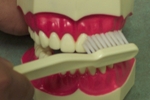 As far as frequency of brushing is concerned, ideally you want to brush your teeth after each meal. This isn’t always easy to do if you’re out at a party or gathering during the holidays. If you can’t brush right after you eat, you should, at the very least, brush thoroughly twice a day, after breakfast and before going to bed.
The holidays are not a good time to get a toothache, with many dentists spending time with THEIR families. Often times you will have to be treated by a covering dentist who doesn’t know your dental issues as well as your primary dentist. Therefore, a checkup prior to the holidays is a very good idea. That way if there are any existing problems, you can address them before you start eating those rich desserts and sweets at the holidays that can aggravate an existing condition.
We have more information and diagrams illustrating proper brushing technique on our website.Friday, October 14, 2011
Is whitening frightening? “Tooth Boss” Dr. Richard Wolfert demystifies teeth whitening.
 Smiling shouldn’t be painful, right? Yet for some people whose teeth are not quite as bright as they’d like, picture time at family functions or during the holidays can be a source of high anxiety. While over-the-counter whiteners can offer modest results, most people are looking for a brighter smile but are fearful of the process and the price tag. With the new technology of teeth whitening out today, dentists can safely whiten teeth without any change or damage to the tooth structure.”
The two main methods of professional whitening are tray whitening and in office whitening. Tray whitening is when a custom tray is made for the patient after an impression is taken, then a supply of whitening gel is given to the patient and he/she will wear the tray for a few hours a day (techniques differ) for a period of time until an acceptable result is achieved. Sensitivity of the teeth is a normal complication of this method of whitening and is transitional.
In office whitening on the other hand is the most effective method of whitening. There are a few different ways that are available for example, Crest White Strips, Britesmile, Zoom, or Laser whitening. The process is similar with all these methods and you can have your teeth whitened in one session with great results.
How much teeth whitening costs depends on the treatment and the dentist. At Smiles By The Toothboss, that can range from $250 to $500 and interest-free payment options are available through CareCredit. But price should be a secondary consideration when whitening your teeth. By having a qualified dentist whiten your teeth, you’re ensuring that you’re using the procedure that works best for your mouth and that you’re getting the best result.
For more information on teeth whitening, you can visit our website or call 781-335-0604 to schedule a consultation.
Subscribe to:
Posts (Atom)