Showing posts with label teeth whitening. Show all posts

Thursday, May 1, 2014

Toothboss shares a smile, donates toothbrushes to DOVE drive

Dr. Richard Wolfert “The Toothboss” donates 144 toothbrush kits to Baker, Braverman & Barbadoro, P.C.’s drive to benefit DOVE, a non-profit that supports victims of domestic violence. (l-r) Dr. Wolfert, Jonathan Braverman, Lisa Kenepp and Theresa Barbadoro
Many women stay in bad situations for fear of not having anywhere else to go. DOVE,a domestic violence assistance organization based in Quincy, Massachusetts, provides options for those women. The law firm of Baker, Braverman & Barbadoro, P.C. in Quincy is trying to help.
The Firm is conducting a personal and household drive to help out the families that utilize DOVE's services. The Toothboss recently donated 144 toothbrush/toothpaste kits to this drive. I encourage everybody to help out this very worthy cause by contributing simple household items.
Items being accepted by Baker, Braverman & Barbadoro, P.C. at their offices on the fifth floor at 300 Crown Colony Drive and in the building’s lobby include:
  • Personal hygiene - toothbrushes, toothpaste, soap, deodorant, nail clippers
  • Bed and bath - shampoo, conditioner, bath towels, washcloths, pillows
  • Kitchen - paper towels, Kleenex, disposable utensils/plates, silverware, pots/pans
  • Cleaning Supplies - floor cleaner, disinfecting wipes, mops, brooms, Windex
  • Feminine hygiene products - sanitary napkins, shaving cream
The general public and fellow tenants of 300 Crown Colony Drive are encouraged to contribute. The drive began on April 14 and will continue through May 30. 
 “We would like to thank Dr. Wolfert for his generous donation of the toothbrushes and kits,” said Paul N. Barbadoro, a partner at The Firm. “This is the second drive we have conducted for DOVE. The response was to our drive for coats and canned goods last November was tremendous. We hope that with the good weather now here, more people, like Dr. Wolfert just did, will come out and help this very worthy cause.”

Friday, February 21, 2014

The Toothboss’ New New Patient Special

New patients are special at the Toothboss. That’s why we provide a thorough, comprehensive exam during your first visit. That includes:

  • X-Rays
  • Blood Pressure Screening
  • Oral Cancer Screen
  • A complete evaluations and written report of findings and options for treatment

A follow up cleaning appointment will be made on completion of the exam. New patients will receive a complimentary Sonicare toothbrush, a $25 value, at the conclusion of your follow-up appointment.

Now isn’t that special?

And if you were referred by a current Toothboss patient, just mention them when you check in and they will receive a $50 gift card to Stockholders in Weymouth.

To schedule your initial visit, call 781-335-0604.

Monday, December 23, 2013

Have a heart, keep brushing your teeth!

Parents have been telling their children to brush their teeth since the beginning of time (perhaps a slight exaggeration). Based on recent evidence linking excellent gum tissue health to a reduction in atherosclerosis—a major contributor to coronary disease--a new trend may be children reminding their parents to brush better and more frequently.

Artherosclerosis is the thickening of arteries through the accretion of calcium, cholesterol and other substances found in the bloodstream. This condition has been linked to fatal cardiovascular complications like coronary heart disease and peripheral arterial disease. According to the findings from researchers from the Columbia University’s Mailman School of Public Health, flossing, brushing and regular trips to the dentist can slow the rate of atherosclerosis.

When people are trying to live a healthier lifestyle, the first things they talk about are eating right and exercise. This report makes a strong case that improving your oral hygiene should be part of the healthier living package. Considering what’s a stake, you can’t argue.

According to the U.S. Centers for Disease Control and Prevention (CDC), cardiovascular disease is the leading cause of death in the United States, killing about 600,000 people each year. That accounts for one-fourth of all recorded fatalities. On average, deaths and illnesses associated with coronary heart disease cost the U.S $109 billion annually.

Part of what makes the results of this study so important is that it shows people a way to improve their heart health that’s really affordable. For merely the cost of brushing your teeth twice a day for a minimum of two minutes, flossing daily, and visiting your dentist at his recommended interval (which can vary depending on each patient needs) can protect you from the devastating results of heart disease.

For complete results of the survey, you can see the entire report on the American Heart Association’s website at http://jaha.ahajournals.org/content/2/6/e000254.abstract


To take your first step to better oral hygiene and a healthier heart, call  781-335-0604 to schedule an appointment. 

Sunday, December 1, 2013

December is oral cancer screening month

According to the Oral Cancer Foundation, 42,000 people in the United States will be newly diagnosed with oral cancer in 2013. To raise awareness among current patients and new patients, we have has declared December "Oral Cancer Awareness Month".

Sure, the national Oral Cancer Foundation has an awareness month that takes place in April but heading into the holidays where people partake in many of the habits that can lead to oral cancers-smoking and drinking-we thought it important to create some additional awareness.

As part of Oral Cancer Awareness month, we will be speaking to patients about the behaviors that can lead to oral cancers, which includes, tongue, tonsillar, and throat cancer. Oral cancers can be genetic, but primarily people who smoke or use other tobacco products, drink alcohol or are exposed to the HPV-16 virus (human papilloma virus version 16), are at increased risk for developing the disease.

Just as we have done for the past 25 years, we will continue to provide an oral cancer screening exams as part of each comprehensive exam that includes examination of the inside part of the cheeks, roof of the mouth the back side and underneath the tongue. As part of their exam, our hygienists, as a result of current research findings, will palpate the lymph nodes located in your neck and underneath your jaw to make sure the usually soft nodes are not hard which can be sign of a problem.

As it is with any cancer, the earlier you detect it the faster you can treat it. And as the numbers indicate, oral cancers are treatable if detected soon enough and that's why we are taking these extra steps to make our patients aware of this risk and be proactive by checking our patients annually.

According to the Oral Cancer Foundation website, "When found at early stages of development, oral cancers have an 80 to 90 % survival rate. Unfortunately, the majority are found as late stage cancers, and this accounts for the very high death rate of about 43% at five years from diagnosis, and high treatment related morbidity in survivors."

For more information, you can visit the Oral Cancer Foundation's website at http://oralcancerfoundation.org/ you due for your next check-up? Please call 781-335-0604 to schedule an appointment.

Monday, November 11, 2013

The Toothboss: A Veteran’s Story

Colonel Richard Wolfert, AKA The Toothboss
Like a lot of veterans, I don’t often talk about my experience in the military. Yet for those who ask where did you come up with a name like “The Toothboss”, you have heard the story about some of my military service. Specifically, the Commander who gave everybody a title and if you were in charge of something, you were the boss. If you ran the mess or cafeteria, you were the mess boss. I took care of teeth, so I was the Toothboss.

What can I say, the name stuck.

For this Veteran’s Day, I thought I would share my story of military service.
I joined the military since 1981 and have served 32 years total. I took a one-year sabbatical in 1988 when I made the transition from the Active Navy and Reserves to the Army National Guard Reserve.

I guess the main reason I joined was I come from a military family. My Dad was involved with making munitions at National Fireworks in Hanover. My two older brothers are Vietnam vets (Marines and Army). Coming from a patriotic family, I felt I should serve.

I think my most significant achievement (other than coming home from Iraq in one piece, physically and mentally) was achieving the rank of a full-bird Colonel about 15 years ago.

I suspected that was going to be my pinnacle and that I'd get out when I got my "20 year letter". When I got to the 20-year point, I realized that duty was somewhat easier at this rank and time in life. With the kids being older (no more missed soccer games, etc. with weekend duty and summer camp) and me enjoying the break it gave me from a solo private practice, remaining in the service enabled me to continue the camaraderie, the testosterone, and the general feeling that I was providing a service to our soldiers with my special training. It gives me a good feeling. 

I can't say the military has made me a better dentist, but it certainly made me realize how important a pain-free mouth was for soldiers to be better decision makers. You don't want the guy with his fingers on an M-16 or a nuclear weapon having a toothache!

The military certainly gave me confidence in myself and in my craft--enough to begin and maintain a private practice for 25 years. It's a good training ground for learning to be a leader and a manager of people. Although I have to admit, managing soldiers (mostly men) is a lot easier than managing a bunch of woman in private practice!

When I go to Veterans Day services, I mostly think about my brothers and those whom served in the Vietnam War. I came home to a United States that was positive about what we were doing in Iraq. I can't imagine what it must have been like for those poor guys getting off the plane from their tour in Vietnam and being lambasted for missions that were not so popular and a military that was not held in the highest esteem. When I came off the plane we were met with people holding flags and handing out paid phone cards so we could immediately call our loved ones. And when I got home the Veteran Service Agent handed me a check for a thousand bucks for duty served.


I’m proud to be a veteran and proud of my family’s history of service. I guess what I think about most on Veteran’s Day is how lucky we are to live in a country where so many of its citizens have been willing and are still willing to serve.

Tuesday, September 17, 2013

Watch your mouth! The Toothboss adds valuable procedures to hygiene services

One of the biggest challenges dentists and hygienists face with patients is not only getting them to brush but addressing the problem areas that normal brushing might not take care of. As part of our hygiene services, we are now using a disclosing solution and a camera so patients can see those trouble spots so they can adjust brushing accordingly.

How it works is simple. The disclosing solution, when applied to the patient’s mouth, adheres to areas of plaque build-up. When we examine your teeth, those notable areas are identified with a pink marker. We can then show you the trouble areas so you know where to focus more attention.
In addition to use of disclosing solution to determine trouble spots, we have added a more complete charting of the gum pockets that surround the teeth, a review of the patient’s health history, a blood pressure screening, and other procedures to complement the normal services his hygienists provide.
The health history is particularly important, particularly if you are on a medication that gives you dry mouth. You see, saliva washes away plaque. If you are on a medication that gives you dry mouth, that means that plaque is not being washed away and potentially doing damage to your teeth and or gums. By making a health history review part of our re-care services, we can address the side effects of medication so it doesn’t harm your teeth.
Are you due for your next check-up? Please call 781-335-0604 to schedule an appointment.

Monday, July 15, 2013

Sugar-free doesn’t exactly mean cavity-free

For those who drink diet soda and other diet drinks, one of your primary arguments for doing so is reducing your sugar intake. While there’s been some documentation that some of the chemicals in diet sodas can play a role in weight gain, there’s mounting evidence that diet drinks with artificial sweeteners can play a role in tooth decay.

The common perception is that if there’s no sugar in a drink then it’s better for your teeth. In theory, that’s true. A regular soda with sugar is worse for your teeth than a diet soda, but that doesn’t tell the entire story.

The bacteria in your mouth will not use artificial sweetener to form acid the way it does with regular sugars. But that doesn't mean a diet soda can't harm your teeth. The diet drinks are acidic on their own without the aid of the bacteria to help form the acid. Both regular and diet soda can demineralize a tooth, causing erosion and cavities. So, although a soda with sugar may be slightly worse at causing cavities and erosion, diet drinks are not without consequences.

So what should diet-conscious consumers drink if sugar and sugar sweeteners are both bad? Good old fashioned water from the tap doesn’t cause any erosion of your teeth over any amount of exposure. It also has no calories. And, depending on your community, even offers fluoride.

Of course, it’s probably not realistic to think that people can drink only water and never have a soft drink. Moderation, as it is with everything, is the key. And if you want to have a diet soda, be sure to brush or at least rinse your mouth out with water shortly after to lessen the exposure to those acids found in diet drinks.”

Beyond drinking water and careful brushing, select drinks that utilize sweeteners made from natural ingredients, like Stevia.

The news on artificial sweeteners, however, is not all bad. In fact, there are sweeteners out there that utilize sugar alcohols that can actually protect against dental cavities, for example, Xylitol.

Xylitol is a natural sweetener sourced from strawberries and other fruits. It’s not in drinks yet, but you can find Xylitol in chewing gums, syrups, candies and tooth pastes. Bacteria in your mouth are not able to breakdown Xylitol when you chew gum or eat candy containing the ingredients. Therefore, no bacterial acids are produced. In the absence of bacterial acids, the process of cavity formation is nullified before it even begins. This makes Xylitol that rare thing – a sweetener that’s actually good for your teeth.

Monday, July 1, 2013

A donation with some teeth to it. Rasin Foundation helps The Toothboss go paperless.

When my dental practice went to paperless files, our primary thought was making the office run more efficiently and being greener. We didn’t realize how this conversion could benefit fellow dentists thousands of miles away in Haiti. Yet that’s exactly what happened when we discovered the Rasin Foundation.

I first heard about the Rasin Foundation, a Milton, MA-based non-profit from a fellow National Guardsmen, Dr. Fidel Gabriel. Fidel is a native of Haiti and he told me of the Foundation’s efforts to get supplies to start a dental practice in Leogane, Haiti. When I asked what types of items the Foundation would accept and mentioned my filing system, it was a no-brainer on this end as to what to do.

The filing system itself costs approximately $2500 but I was prepared to eat the cost of that because I believe going paperless far outweighed the cost. To find an organization like the Rasin Foundation that could benefit from the donation of the filing system was icing on the cake. The fact it was going to help a dental practice was the cherry on top.

As you can imagine, the equipment and technology that we enjoy and perhaps take for granted here in the U.S. aren’t available in remote places like Leogane, Haiti. I encourage dentists, doctors and other health care professionals to visit The Raisin Foundation’s website to see if they need other items. One man’s upgrade is another’s treasure.


For more information, visit www.RasinFoundation.org.

Thursday, June 13, 2013

Is a sports drink worse than a soda? Ask the Toothboss.

There’s the perception that sports drinks are good, soda is bad. Sports drinks hydrate, soda dehydrates you and, worse, is loaded with sugar. While you probably won’t find any dental health professional recommending a soda any time soon, it might surprise you to know what dentists view as the lesser of two evils—at least when it comes to the well-being of your teeth.

Most sports and energy drinks are loaded with sugar. In the short-term, they can re-energize you and rehydrate you somewhat. But if you drink several a day you are putting your teeth at serious risk. How? The sugar in the sports drink can combine with the bacteria in placque that has adhered to your tooth’s surface. These acids erode the enamel surface leading to cavities.

So is soda better for you than a sports or energy drink? According to a study contracted by the Academy of General Dentistry it is.

The AGD study considered what continuous exposure to a variety of “soft” drinks would do to your teeth, specifically the enamel portion of the tooth, over a 14-day period. Continuous exposure was considered several servings over the course of a 12-hour period.

The results revealed the erosion of a tooth’s enamel in milligrams:

·         Snapple Classic Lemonade – 30mg
·         Red Bull – 22mg
·         Gatorade (lemon-lime) – 20mg
·         Propel Fitness Water – 14mg
·         Arizona Iced Tea – 9 mg
·         Coca Cola – 3mg

So, technically, soda is better for your teeth than the sports drinks that promise to restore your electrolytes and other health benefits. But does that mean dentists endorse soda over sports drinks? Hardly.

The lesser of two evils is still an evil. What that study doesn’t reveal is that good old fashioned water from the tap doesn’t cause any erosion of your teeth over any amount of exposure. It also has no calories. And, depending on your community, even offers fluoride.

Of course, it’s probably not realistic to think that people can drink only water and never have a soft drink. Moderation, as it is with everything, is the key. And if you want to have a sports drink or soda, be sure to brush or at least rinse your mouth out with water shortly after to lessen the exposure to those sugars can do.

Monday, May 13, 2013

Going to the dentist is for the birds.

A patient's view at The Toothboss
Actually, the birds are for the patients. At least that’s what we tell patients when seated in our examination rooms and looking out the window to see a plethora of birds feasting at our bird feeder. The fact is we enjoy checking out the cardinals, finches, chickadees, woodpeckers and other birds those feeders attract.

Going to the dentist can be an unnerving experience for some patients. With our newly renovated waiting room and office area, as well as our examination rooms, we try to create a calming, stress-free environment. The bird feeders are part of that effort (we also have a fish tank in the dental hygienist’s examination room).

The bird feeders serve a couple of purposes. First, they offer a distraction for patients to take their mind off what the work being done (we positioned the feeders so patients can view the birds and keep their head in position for their examination). Second, bird-watching does have a soothing effect. This can be particularly effective with younger patients who are easily distracted.


For some patients, a trip to the dentist can cause debilitating anxiety that interferes with the dentist being able to do their work. For some people who are biters, their anxiety can create a dangerous situation for the dentist. That’s why many dental practices, including The Toothboss, offer sedation therapy as a stress-free way to get your dental work done. 

Friday, April 19, 2013

What’s missing in bottled water for kids? Plenty.

Give parents a choice between soda, a juice box or a bottle of water for their children and most would probably go for the bottle water. What many people don’t realize is that opting for bottled water, though better for their children than soda or sugar-loaded fruit juice, is missing a key ingredient their children need: fluoride.

Fluoride is critical for growing strong, healthy teeth. For younger patients, fluoride actually hardens teeth, making them more cavity-resistant. Unfortunately, more and more people are opting for bottled, filtered water, which has no fluoride.

Some communities, like Weymouth, have fluoride in the water—a great way to help their children grow strong healthy teeth. Because of the taste, many people prefer bottle water or filtered water over tap water and pass that habit on to their children. But kids still need fluoride to help their teeth develop.

How much? According to the American Dental Association, children should consume fluoride through drinking water or supplements in the following amounts:

·         Birth to six months – none
·         Six months to three years - .25 mg/day
·         Three to six years - .5 mg/day
·         Six years to 16 years – 1 mg/day

Many dentists have younger patients take fluoride supplements, whether they live in a community where the tap water has fluoride or not. If your child is under 10 and not taking supplements, please contact our office at 781-335-0604.


To find out whether or not your town is a fluoridated community, please click on this link to go to a map from the Massachusetts Dental Society website, www.massdental.org. You can also call your town’s Water Department.

Friday, June 22, 2012

Do you know what your dental insurance covers?


Dental benefits first became available in 1974. Back then, the average benefit coverage was $1,000. Does that sound familiar? If you have dental coverage it probably does because the average dental benefit in 2012 is about $1,000.

To put that into perspective, in 1974, a brand new Mustang cost about $2500. Today, a 2013 Mustang starts at $22,200!

What this means for patients is you need to know what your dental insurance covers and up to how much. Then, when you visit the dentist for more than a cleaning or check-up, ask him or her if your dental plan covers the procedure. Or, how much will it cost out of pocket.

For example, some people prefer composite fillings, which are white, compared to the traditional amalgam fillings. There is a price differential between the two filling types, composite are more expensive. Most insurance plans will not cover the difference. Consequently, many people who want composite fillings end up paying $50 or more out of pocket.

That’s not to be completely critical of dental insurance plans. Many of the most severe problems patients come to me could have been avoided with better daily care on their part and regular trips to the dentist for check-ups. And dental insurance, if nothing else, does make it easier for people to get to the dentist regularly. But if you need more than a check up, a call to your dental insurance provider about what’s covered is a great start.

Friday, April 27, 2012

Random oral hygiene and dental health facts


I was recently perusing the American Dental Hygienists Association website and came across some rather interesting facts. In no particular order, here they are:
  • Snacking on celery, carrots, or apples helps clear away loose food and debris.
  • Toothbrushes should be replaced every two to three months and after illnesses like a cold or flu.
  • Oral cancer occurs twice as frequently in men as women
  • Dental hygienists screen for serious health problems, such as HIV infection, oral cancer, eating disorders, substance abuse and diabetes.
  • Chewing gum can help eliminate food particles caught between teeth after a meal and also helps prevent plaque build up by stimulating saliva production.
  • The biggest oral health problem for infants is early tooth decay, known as baby-bottle tooth decay. This results when babies routinely fall asleep with bottles filled with sugary liquids such as milk, formula, and juice—anything other than plain water.


Friday, April 13, 2012

Win a gift card to Stockholders for new patient referral

Don't let the subject line fool you. Smiles by the Toothboss is not putting out any IPOs or looking for investors. We are looking for new patient referrals and the reward for each new patient referral is a $50 gift card to Stockholders Steakhouse Chophouse and Seafood, located at 1073 Main Street (Route 18) in South Weymouth.

To qualify, the person you refer must be a new patient, never been seen before by Smiles by the Toothboss. Your referral must mention you by name as a current patient. Better yet, forward a copy of this e-mail to them with your name and e-mail address on it. The person you refer must undergo a comprehensive exam, which will include x-rays, cleaning, for you to be eligible. After their appointment, we will mail out your gift card to Stockholders.

Some of the patients who have been with us the longest came by referral. Jeanne McCormick referred her daughter, who in turn referred her husband. Jeanne also referred her son who brought in his wife. She also told her brother about the Toothboss who then brought in his wife. And if that weren't enough, Jeanne referred two of her married friends who brought in their kids. Wow! 

So if you've been happy with the care you've received at Smiles by the Toothboss, please feel free to share that with friends and family. You don't have to refer as many people as Jeanne. Just one could make you the majority shareholder in a night out at Stockholders.

Friday, February 24, 2012

Startling facts about oral hygiene and heart disease

We all know that heart disease is the leading cause of death for both men and women. Did you know that forgetting to brush your teeth at least twice a day increases your risk of heart disease by 70 percent?

How about this: men and women with periodontical disease are almost twice as likely to suffer from coronary artery disease as those without? Or that a periodontical disease can greatly exacerbate an existing heart condition?

Perhaps that's why it's no surprise that nearly 20 million Americans who do visit their dentist each year do NOT have to see their doctor.

Friday, February 17, 2012

Smiles by the Toothboss switches to paperless records, renovates office space.

Some people just don’t like to go to the dentist’s office. As a dentist, that’s a fact you have to accept. Still, we’re doing everything n our power to make the visit to the dentist a more comfortable experience by undergoing a number of cosmetic and operational improvements.

The renovations began with a conversion to digital radiography so that all X-rays and records are now stored electronically. This makes treatments easier to diagnose and record-keeping more efficient. Also, removing large filing cabinets from the work area enabled the construction of a more spacious, ergonomically sound space for our staff, which has grown in numbers over the years.

Dentists realize the apprehensions people have about coming to the dentist are based on their own fears. Still, how an office appears and how work flows can affect how patients perceive the experience and exacerbate those feelings. These improvements have made us more efficient and ergonomically sound as we now have reception desk that can comfortably seat two staff members who aren’t reaching over each other while serving patients and that puts everyone at ease.

Being paperless is another huge benefit. Beyond the storage issues, just not having a paper record makes for a much more hygienic environment, as well as being more private.
We anticipate the renovations being completed over the next month. Thank you for your patience while we undergo these improvements.

Tuesday, December 20, 2011

Dental Insurance 101. What you don’t know could you hurt you and your wallet

Most dental plans cover basic examinations and cleanings, but some plans may not cover things you might assume to be routine. Most misunderstandings occur when patients believe their insurance will or should pay for more than it will.

Most dental insurance companies classify dental procedures in three categories:
  • Preventative – This typically includes routine cleanings and examinations as preventative dental care, however, X-rays, sealants and fluoride can be deemed as preventative or basic, depending upon the specific insurance carrier. 
  • Basic or Restorative – This usually consists of fillings and simple extractions. Root canals can be considered basic or major depending on the plan (the majority of dental plans list root canals as basic).
  • Major – Usually includes crowns, bridges, dentures, partials, surgical extractions and dental implants. But not always.
When it comes to dental insurance, most people want it and are glad to have it. When it’s time to actually use the insurance on something other than a routine cleaning--like an unexpected filling, a chipped tooth there or worse, a root canal or crown—it’s a little too late. Doing a little research into your insurance benefit before you really need it is a wise move and can help minimize out-of-pocket costs from unexpected dental treatments.

Wednesday, November 16, 2011

Brushing up on your holiday eating. How to brush to keep holiday sweets from leading to a trip to the dentist

When it comes to holiday sweets, most people worry about what it will do to their waist line. Not much thought is given about what an increase in sweets can do to their teeth. While you might assume a few extra trips to the gym after the holidays will take care of the sweets, the potential damage to your teeth from an increase in sweets can be more troublesome.

If you are continually eating sweets all day long because candy or other sugary treats are available, it raises the acid levels in your mouth to a higher than normal level and that can lead to an increase in demineralization of the enamel and cavity formation.
Also, the sticky nature of most candy provides the bacteria with more opportunity to create the acid that causes all the problems. And, it goes without saying that sticky candies and sweets are not the best thing to be eating if you have crowns, bridges or other prosthetic appliances in your mouth that can be ‘pulled’ out.”

Does that mean you shouldn’t have any sweets during the holidays? No, sweets in moderation are fine. The real issue stems back to people’s brushing habits in general.
The simple fact is most people do not know how to properly brush their teeth, both from a technique standpoint, length of time and frequency.

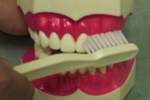
After selecting a good toothbrush and toothpaste (Dr. Wolfert recommends a soft brush and any toothpaste with fluoride), a good brushing should take at least two minutes and as many four. While there are many different techniques for brushing, here is one of the more popular ways:
  • Hold the brush on two to three teeth with a 45 degree angle on the teeth and under the gum. Gently press against the gum so the tips of the bristles go in between the gum and the teeth. 
  • Apply lateral pressure, making the motion of little circles with the final stroke away from under the gums in order to sweep the plaque away from the teeth and the gum. 
  • Repeat this motion six to 10 times and move on to the next area of two to three teeth. If your mouth is full of foam, rinse out with water and continue brushing. Your brushing is completed when you have brushed all the surfaces of your teeth; the front, backs and tops of all teeth.

As far as frequency of brushing is concerned, ideally you want to brush your teeth after each meal. This isn’t always easy to do if you’re out at a party or gathering during the holidays. If you can’t brush right after you eat, you should, at the very least, brush thoroughly twice a day, after breakfast and before going to bed.

The holidays are not a good time to get a toothache, with many dentists spending time with THEIR families. Often times you will have to be treated by a covering dentist who doesn’t know your dental issues as well as your primary dentist. Therefore, a checkup prior to the holidays is a very good idea. That way if there are any existing problems, you can address them before you start eating those rich desserts and sweets at the holidays that can aggravate an existing condition.
We have more information and diagrams illustrating proper brushing technique on our website.

Friday, October 14, 2011

Is whitening frightening? “Tooth Boss” Dr. Richard Wolfert demystifies teeth whitening.

Smiling shouldn’t be painful, right? Yet for some people whose teeth are not quite as bright as they’d like, picture time at family functions or during the holidays can be a source of high anxiety. While over-the-counter whiteners can offer modest results, most people are looking for a brighter smile but are fearful of the process and the price tag. With the new technology of teeth whitening out today, dentists can safely whiten teeth without any change or damage to the tooth structure.”

The two main methods of professional whitening are tray whitening and in office whitening. Tray whitening is when a custom tray is made for the patient after an impression is taken, then a supply of whitening gel is given to the patient and he/she will wear the tray for a few hours a day (techniques differ) for a period of time until an acceptable result is achieved. Sensitivity of the teeth is a normal complication of this method of whitening and is transitional.

In office whitening on the other hand is the most effective method of whitening. There are a few different ways that are available for example, Crest White Strips, Britesmile, Zoom, or Laser whitening. The process is similar with all these methods and you can have your teeth whitened in one session with great results.

How much teeth whitening costs depends on the treatment and the dentist. At Smiles By The Toothboss, that can range from $250 to $500 and interest-free payment options are available through CareCredit. But price should be a secondary consideration when whitening your teeth. By having a qualified dentist whiten your teeth, you’re ensuring that you’re using the procedure that works best for your mouth and that you’re getting the best result.  

For more information on teeth whitening, you can visit our website or call 781-335-0604 to schedule a consultation.